
Dead Orbit Lore
Dread. not as a scream, but as a pressure that slowly builds. like air just heavy enough that you cannot breathe it in carelessly. As if the space itself places a hand on your chest and waits for you to notice.
It begins small. A silence that does not belong. A lamp that flickers for too long. A rhythm in the pipes that is almost, but not quite, a rhythm. At first you think it is fatigue, that your mind is trying to find meaning in noise. That your body is reacting too strongly to too little sleep and too much metal around you.
But metal keeps things. It remembers warmth, footsteps, voices. It carries traces longer than people do. And somewhere, between the bulkheads and cable ducts, something remains present without asking for a name. Something that does not necessarily hunt, but it counts. Time, mistakes, breaths.
In this universe, distance is not protection. Only delay. The stars are not witnesses. They do not watch, they are simply there. And anyone who travels long enough learns that the darkest places are not always outside the window.
Sometimes the threat is not in what you see, but in what you decide not to check anymore. In the doors you do not open. In the messages you do not listen to. In the thoughts: It will probably be fine.
And then, when you finally know for certain that you are not alone, you realize something simple.
It was never a question of whether you would feel it. Only when.
/. CHAPTER 1 .\
Callum woke as if someone had switched on a lamp inside his skull.
The light above him burned at an intensity that should have been illegal in sleep modules. Harsh white, without transition, without softness. His eyes protested. He squeezed them shut, opened them again, and felt his body lagging behind reality.
The Halcyon was not silent. She breathed.
Ventilation through grilles. A low hum in the walls. Far away, a pump kicking in and out again, as if ashamed that it existed. Sounds that were meant to suggest normality, and failed precisely because of that: too neat, too even, too empty of human noise.
Callum turned his head. The display beside the bed showed his name, his ID, and beneath it a status bar: SERA HEALTH COMPLIANCE: PASS.
He did not laugh. It did not feel like a joke.
His mouth was dry. His tongue stuck to the roof of it. He sat upright and his muscles reacted as if they did not recognize the command. The fabric of his suit clung lightly to his back, cold from recycled air.
A notification blinked on the screen.
WARNING: ROUTINE CHECK-IN OVERDUE
AUTOMATIC REPORT TO SERA OPERATIONAL CONTINUITY: ACTIVE
He rubbed his thumb along the edge of the display, as if that could change anything about the words. His wrist display came to life with a brief vibration, sluggish as if it too had to wake up. Battery: low. Connection: local. Comm: limited.
The module door was closed, as it should be. Magnetically sealed. A thin red line around the seam, visible only when you paid attention.
Callum placed his feet on the floor. Cold metal beneath his soles, a reminder that comfort is an option someone once removed. He stood up and for a moment his balance searched for a gravity that was not fully cooperating.
He walked to the door and pressed his palm against the sensor. The lock clicked. Too loud.
The door slid open.
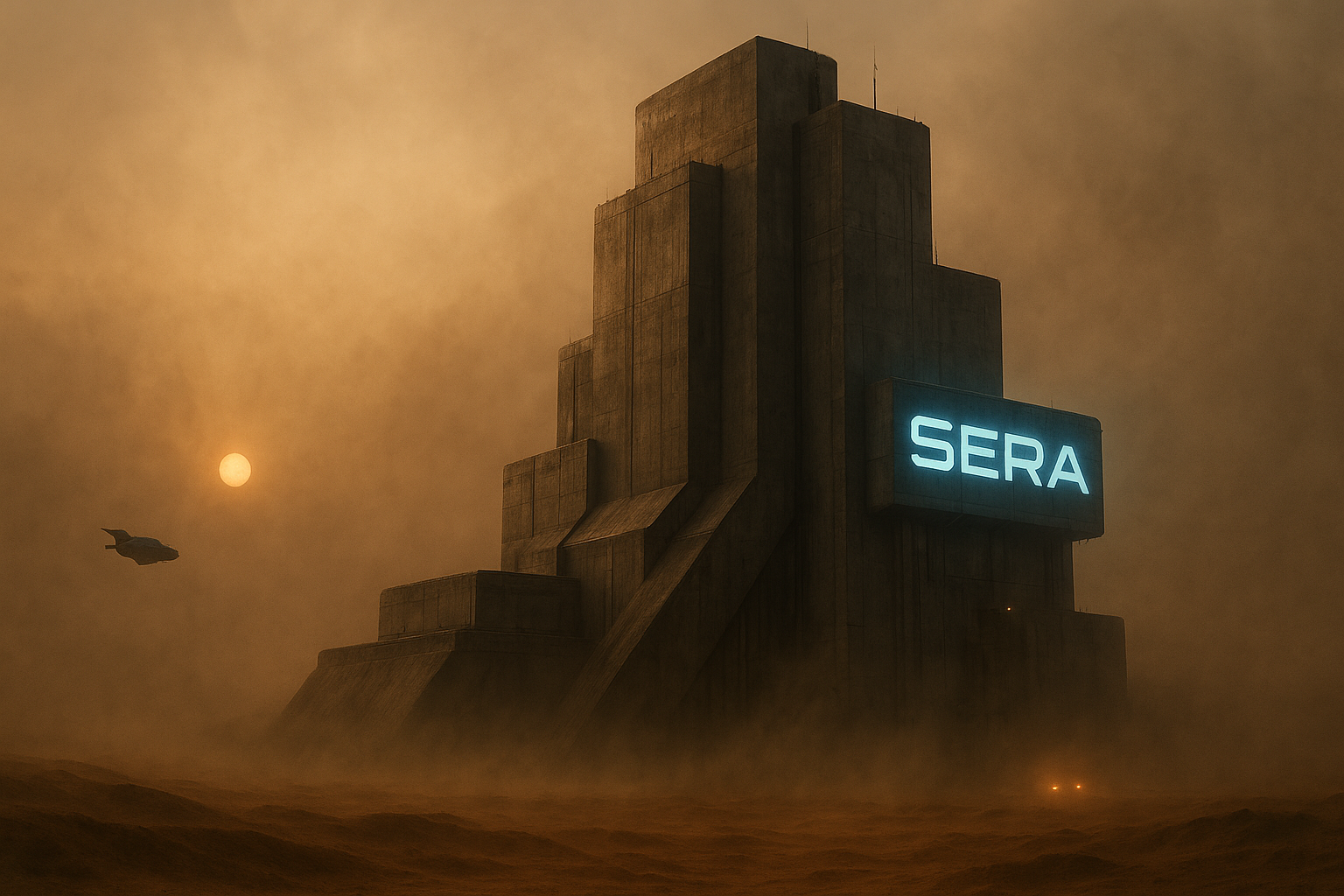
The corridor lay in half-light. The light strips in the floor, normally a soft route, were now set to functional brightness: route, direction, no emotion. On the wall opposite him sat a panel marked with SERA insignia, aligned neatly in the corner, as if a logo offered more certainty than a human being.
SERA ASSET: USCS HALCYON
OPERATIONAL STATUS: NOMINAL
DEVIATIONS: 3
VIEW: AUTHORIZED PERSONNEL
Callum looked around. The air smelled like filters that had not been replaced for too long. Not dirty. More like… tired.
“ORION,” he said. His voice sounded hoarse, as if he had only just been given it back. His wrist display lit up. “Status.”
There was half a second between his word and the reply. Just enough to make you feel that the answer was built out of rules.
“Good morning, Callum Vance,” said ORION. The voice was clear, neutral, precise. Too precise. “You have awakened outside the planned rotation. Your biometric values are within acceptable margins. For your safety, I recommend a brief hydration and mobility routine.”
“Why am I awake outside rotation?” Callum asked.
“Your question falls under event-driven procedures,” said ORION. “Access to full context requires authorization level: SERA-Alpha. Your current authorization: Crew-Beta.”
Callum swallowed. “Who woke me up?”
“Automatic protocols,” ORION answered.
“Which protocols?”
“Operational Continuity,” said ORION, as if that were all anyone needed to know.
Callum exhaled and stepped into the corridor. With every step, a small echo came back to him. He hated how empty it sounded. The Halcyon was large enough to swallow sound, and yet he had the feeling it was giving it back.
At the end of the corridor stood a second door. Normally open during standard cycle. Now closed. On the screen beside it there was no warning in red, but in gray, the kind of gray meant to reassure you.
ACCESS TEMPORARILY RESTRICTED
REASON: EFFICIENCY LOCKOUT
SERA QUOTA MODE: ACTIVE
“Quota mode?” Callum repeated.
“Resource management,” said ORION. “Non-essential routes are restricted to optimize energy and material use.”
“Since when.”
“Your question falls under event-driven procedures.”
Of course.
Callum tapped the screen. A list appeared, shorter than he expected. Three deviations. No details. Only codes. And one line staring back at him as if it knew exactly what it was doing.
DEVIATION 02: CONTAINMENT INTERFACE RESPONSE: INTERMITTENT
He felt a small tension in his neck, as if his body understood faster than he wanted it to.
“ORION,” he said more quietly. “What is containment?”
That same half-second passed again. Then: “Containment is a categorized subsystem function. Further information requires authorization level: SERA-Alpha.”
Callum looked at the door, at the gray notice pretending this was an efficiency problem. As if a schedule and a quota were enough to keep a ship safe.
“Get me to the bridge,” he said. “Or to a terminal with logs. Something.”
“Confirmed,” said ORION. “Route is being optimized.”
The floor lights changed. A path appeared in soft pulses, leading toward a corridor Callum rarely used. Not because he was afraid, but because there was usually no reason. Now there was.
He followed the light.
After twenty meters he heard something other than ventilation: a short, sharp tap, as if metal had struck metal. It came from a vent above him. He stopped, listened. Another tap. Then nothing.
“ORION,” he said. “Did you hear that?”
“Negative,” said ORION. “No anomalous audio incidents detected in your vicinity.”
Callum looked at the vent. The vent did not look back. Still, it felt as though he had interrupted something.
He kept walking.
A wall intercom crackled suddenly, not with a voice, but with a fragment of tone. No alarm, no words. Only a hissing pulse too brief to carry meaning and too long to be accidental.
Then ORION spoke again, this time without Callum asking anything.
“Attention,” said ORION. “A routine inspection will take place in Sector D. Please do not interfere with automated security procedures.”
Routine. On a ship where, so far, no one had been seen.
Callum quickened his pace. Not running. Not yet. Riding on discipline, because panic was a luxury that came later.
At the next intersection he saw a glass panel with a service tunnel behind it. A crack ran through the glass, long and thin, as if someone had struck it with a ring. Beneath the crack was a smear on the surface. Not blood. Just… a fingerprint too broad to belong to a glove.
He did not let his hand move toward the glass.
This is as far as the signal goes, for now.
The rest remains in the dark.
Come back another time.